This bottling line runs at 54% efficiency. You get one move to raise it: fix one interrupt, or add buffers between machines. The obvious move isn’t always the best one. ReliaSim® scores yours over ten 90-day runs, and the board shows who got the most out of the line.
Top score wins a free line assessment.
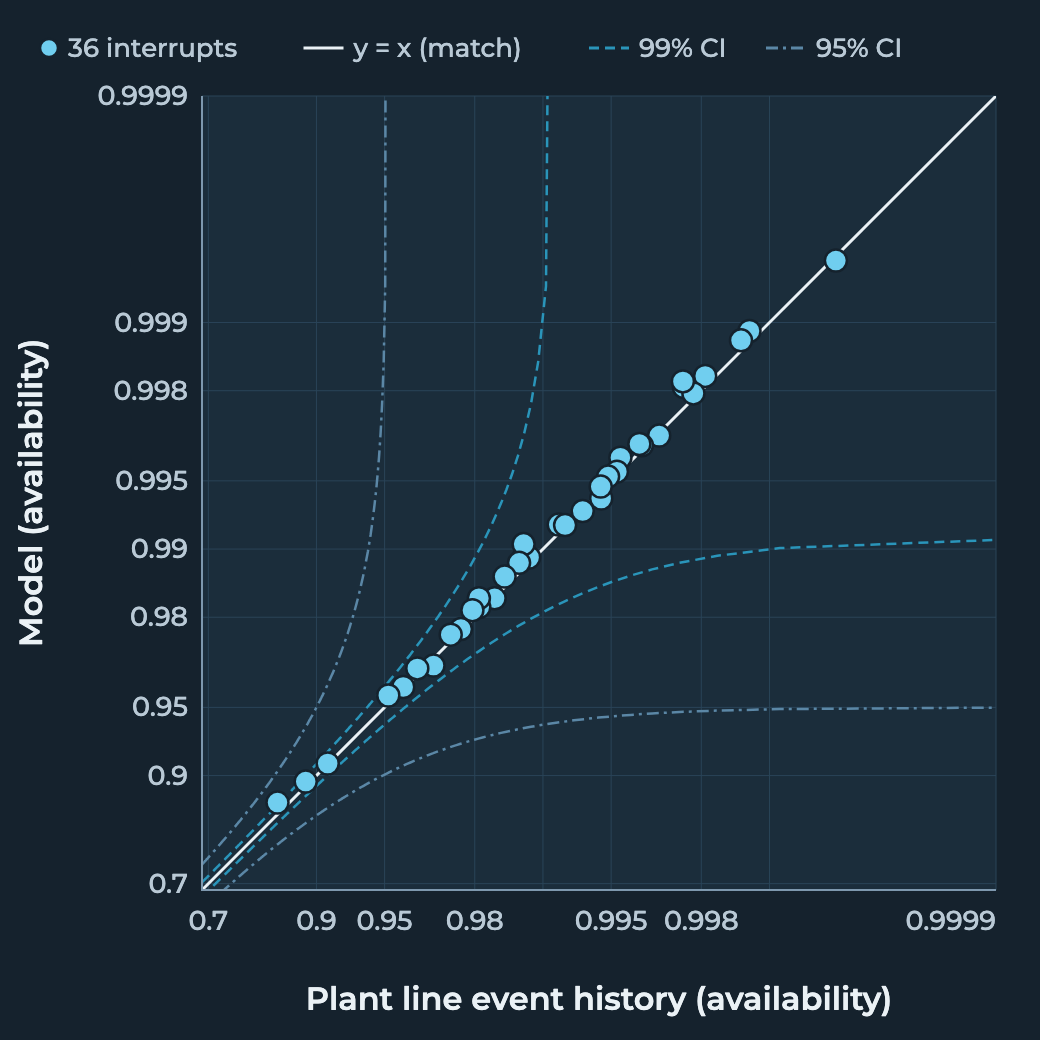
Beat the Bottleneck puts a bottling line in front of you and asks the question the Theory of Constraints starts with: what limits the line, and what is the one change that gets the most out of it? Fix one of 27 interrupts or add buffers between machines, then ReliaSim® runs your line ten times, 90 days each. ReliaSim is ChiAha’s production line simulation software, validated against a published plant model (Fischel & Lange, WSC 2020: within 1% of measured OEE).
It’s free and competitive: plant teams play it together in workshops and training sessions, and the board shows who got the most out of the line. After your move, try three rules of thumb plants use to pick a fix: the downtime Pareto, the worst machine’s chronic stops (TPM) and protecting the constraint (Theory of Constraints).
ReliaSim training for plant teamsBuild this game for your plantreliasim.com
Also on iPhone and iPad. Get Beat the Bottleneck on the App Store
The board shows your first name, last initial and company. We’ll email you your result, then five short notes on what the game teaches over two weeks. Unsubscribe in one click.

A fix gets rid of one cause of stops. A buffer doesn’t prevent stops, but it keeps the machines on either side of it running for a while when one of them goes down.
Each interrupt shows how many times it stopped the line and how long the line was down: over the 90 days ReliaSim runs, or on an average 8-hour shift (the line runs 24/7, so 90 days is 270 shifts). Your score is always for the 90 days. Choose one to see how long it runs between stops and takes to repair. There are no buffers, so every stop stops the line.
Your score is the line’s output, not the hours you save.
You have 4 slots. Each slot holds 100 bottles at Buffers 1 and 2, or 100 cases at Buffer 3.
A buffer helps most where the machines on either side of it stop at different times.
Ten randomized runs of 90 days each.
60 minutes on a five-machine line, rolled with the class dice. Each person is one machine on a line, or play all five alone.
Line name
Your seat
Stop at 60. Line availability
Lines in this room
Line efficiency with your improvement
Want this run on your line? Book a call
Scores come from ReliaSim engine runs of this line: the average of ten 90-day runs for your exact setting. Your best play counts.
Learn more: Find the bottleneck · How big should a buffer be? · Lean, TPM or TOC? · All guides
Here are three common ways to decide what to fix first. Pick one, then put it to the test on the line as it is.
Start over with the line as it is and take four steps, one at a time. Each step fixes one interrupt or adds one buffer slot. Your score is the average line efficiency over the four steps, so the order matters.
Gain/Loss runs your line with each next step and shows how much each one would add. It tells you the best next step.
Standings with emails, hide, CSV and the drawing are on the staff admin page.